Case · Product Design Lead · UX Architecture

Redesigning the experience architecture for time management software

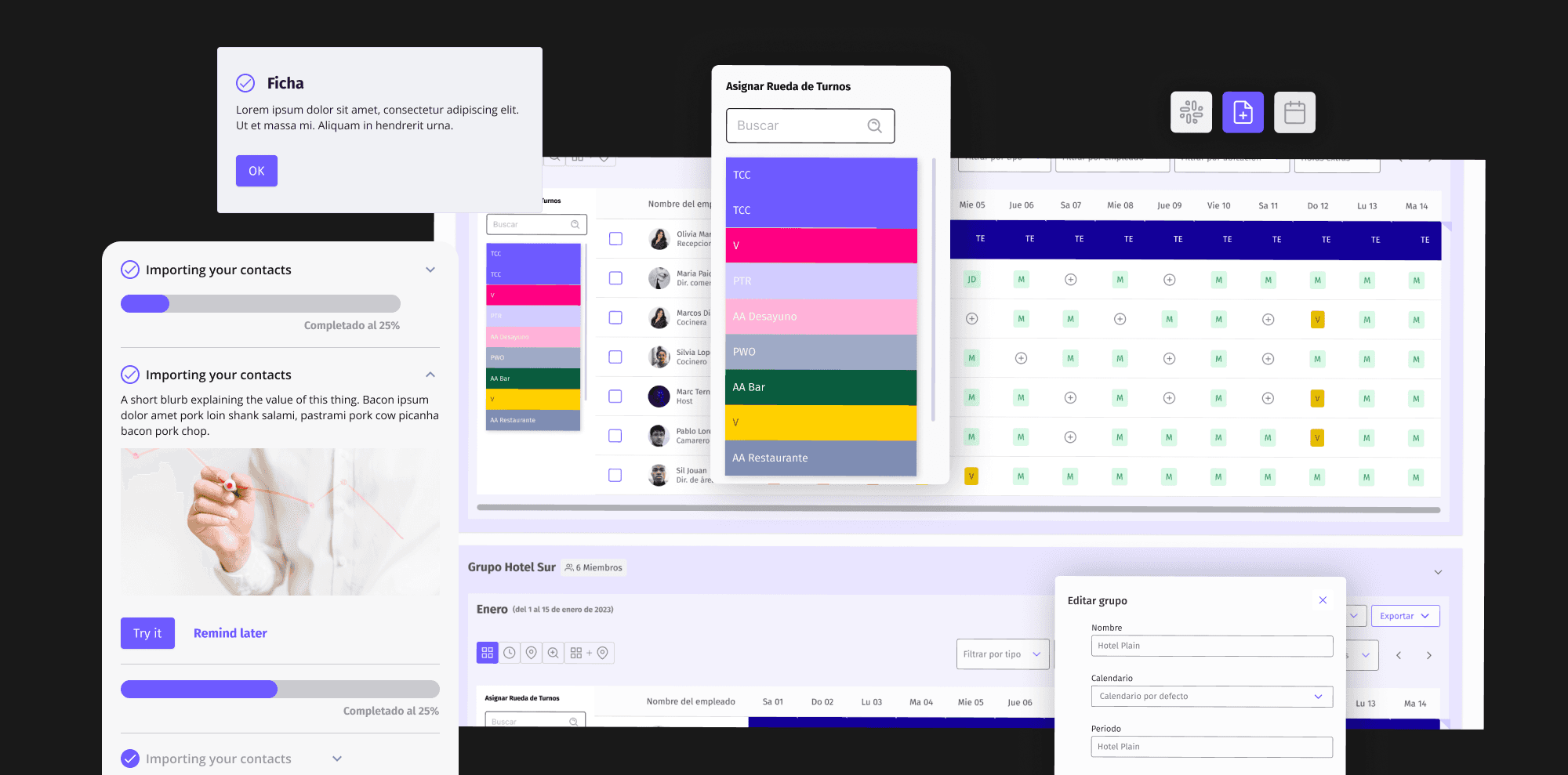
Plain had a functional product, but its experience needed to evolve to improve navigation, reduce friction, and facilitate schedule management in different use cases. The challenge was not just to redesign screens, but to understand how users organized their time, what decisions they needed to make within the product, and what information had to be available at any given moment. The goal was to build a clearer, more scalable, and easy-to-use experience, while keeping the focus on efficiency, personalization, and consistency.

Plain had a functional product, but its experience needed to evolve to improve navigation, reduce friction, and facilitate schedule management in different use cases. The challenge was not just to redesign screens, but to understand how users organized their time, what decisions they needed to make within the product, and what information had to be available at any given moment.

Role

UI Lead · Design System Specialist

Company

Plain

Year

2023

platforms

Figma

COMPLETE PROJECT

Apply in interview
My Role

As Product Design Lead, I worked on product analysis, UX research, redefinition of the information architecture, and the design of new user flows.

I also developed wireframes and prototypes to explore solutions, validate structure, and facilitate conversations with product, business, and development.

My focus was on giving direction to the design process: identifying frictions, setting priorities, defining experience criteria, and transforming complex problems into concrete solutions.

The challenge

The product needed a clearer, more flexible experience that was easier to evolve.

Time tracking involves working with changing information, different user profiles, and operational decisions that must be resolved quickly. Therefore, the main challenge was to organize the information architecture and simplify key user journeys without losing functional depth.

The goal was to build a more understandable, efficient, and scalable experience foundation.

Discovery and UX direction

The project began with a discovery phase aimed at understanding the product logic, the different management scenarios, and the main points of friction in usage.

I organized the findings, identified priority problems, and defined experience criteria to guide the evolution of the product. The goal was to build a shared UX direction before moving toward visual solutions.

The flows, wireframes, and prototypes functioned as tools for decision-making and alignment with stakeholders, allowing early discussions about scope, hierarchies, behaviors, and dependencies.

How I approached it

01

Product research and analysis

Review of the existing experience to detect friction points, navigation inconsistencies, and areas where information was not sufficiently prioritized.

The analysis made it possible to identify opportunities for improvement in the way users accessed, understood, and managed information related to schedules and availability.

02

Information architecture redefinition

I worked on a new organization of content and features to make the product more intuitive.

The focus was on simplifying navigation, reducing unnecessary steps, and making the main actions more visible and easier to execute.

03

User flow design

I defined new user flows to represent key usage scenarios, prioritizing clarity, efficiency, and continuity between screens.

These flows helped align design decisions with real product needs and facilitated discussions with stakeholders and the technical team.

04

Wireframes and prototypes

I developed wireframes to explore interaction solutions before moving on to visual design.

The work allowed for the early validation of interface structure, hierarchy, and behavior, reducing uncertainty and facilitating decision-making.

05

Experience personalization

One of the focuses of the project was to propose solutions that would allow the experience to be adapted to different types of users and management contexts.

Customization was addressed from the perspective of navigation, information visualization, and how the product could respond to different operational needs.

How I approached it

My contribution as Product Design Lead

  • Product analysis and friction detection.

  • Prioritization of experience issues.

  • Redefinition of information architecture.

  • Design of workflows for different profiles and scenarios.

  • Facilitation of decisions through wireframes and prototypes.

  • Alignment between product, business, and development.

Impact

⛵︎

Clearer navigation

The new architecture made it possible to better organize the information and facilitate access to the main features.

⇢

More efficient workflows

The new journeys reduced friction and helped make key tasks more direct and understandable.

⌖

Better product alignment

The wireframes and flows facilitated the conversation with stakeholders and helped convert experience issues into concrete design decisions.

Learning

This project reinforced the importance of working on information architecture as a strategic layer of product design. In management products, the experience depends not only on a visually clear interface, but on how the decisions, data, and actions that people need to perform in their day-to-day lives are organized.

Do you need to improve the overall navigation of your product?

How I approached it

01

Product research and analysis

Review of the existing experience to detect friction points, navigation inconsistencies, and areas where information was not sufficiently prioritized.

The analysis made it possible to identify opportunities for improvement in the way users accessed, understood, and managed information related to schedules and availability.

02

Information architecture redefinition

I worked on a new organization of content and features to make the product more intuitive.

The focus was on simplifying navigation, reducing unnecessary steps, and making the main actions more visible and easier to execute.

03

User flow design

I defined new user flows to represent key usage scenarios, prioritizing clarity, efficiency, and continuity between screens.

These flows helped align design decisions with real product needs and facilitated discussions with stakeholders and the technical team.

04

Wireframes and prototypes

I developed wireframes to explore interaction solutions before moving on to visual design.

The work allowed for the early validation of interface structure, hierarchy, and behavior, reducing uncertainty and facilitating decision-making.

05

Experience personalization

One of the focuses of the project was to propose solutions that would allow the experience to be adapted to different types of users and management contexts.

Customization was addressed from the perspective of navigation, information visualization, and how the product could respond to different operational needs.